
00:00
/
00:00
Building automation in the renovation roadmap: The most cost-effective measure with the greatest impact

Imagine a building owner who owns an office building from the 1990s. The energy efficiency rating is F, EPBD deadlines are approaching, and the budget is nowhere near enough to replace the roof, facade, and heating system all at once. Every owner of an existing building eventually faces the same question: Where do I start if I want to reduce CO₂, energy consumption, and regulatory risk as much as possible with limited capital?
An obvious but often underestimated answer is building automation. It is far more than just a comfort gadget—as a lever for energy and comfort it enables savings potential of 20% to over 35%. But this immediately raises the next question for our building owner: How does this lever perform in a direct comparison with classic alternatives like insulation, window replacement, or a new heat pump? And what should they actually start with?
The regulatory pressure in the background
The reason our building owner has to act at all is due to a whole range of regulatory and strategic drivers—from stricter EPBD efficiency standards and mandatory automation requirements to rising CO₂ prices and the "brown discount" in the real estate market. We have already described the details of this in a previous article . One thing is clear: choosing the right first renovation measure is not just an economic decision, but also a regulatory race against time—which is exactly why a cost comparison is so valuable.
Building automation vs. classic renovation measures: The cost comparison
For owners and operators of real estate portfolios, building automation competes with a whole range of established energy renovation measures—such as roof and facade insulation, window replacement, PV integration, or heating system upgrades. A look at the numbers quickly makes it clear why the order in which you tackle these measures matters:
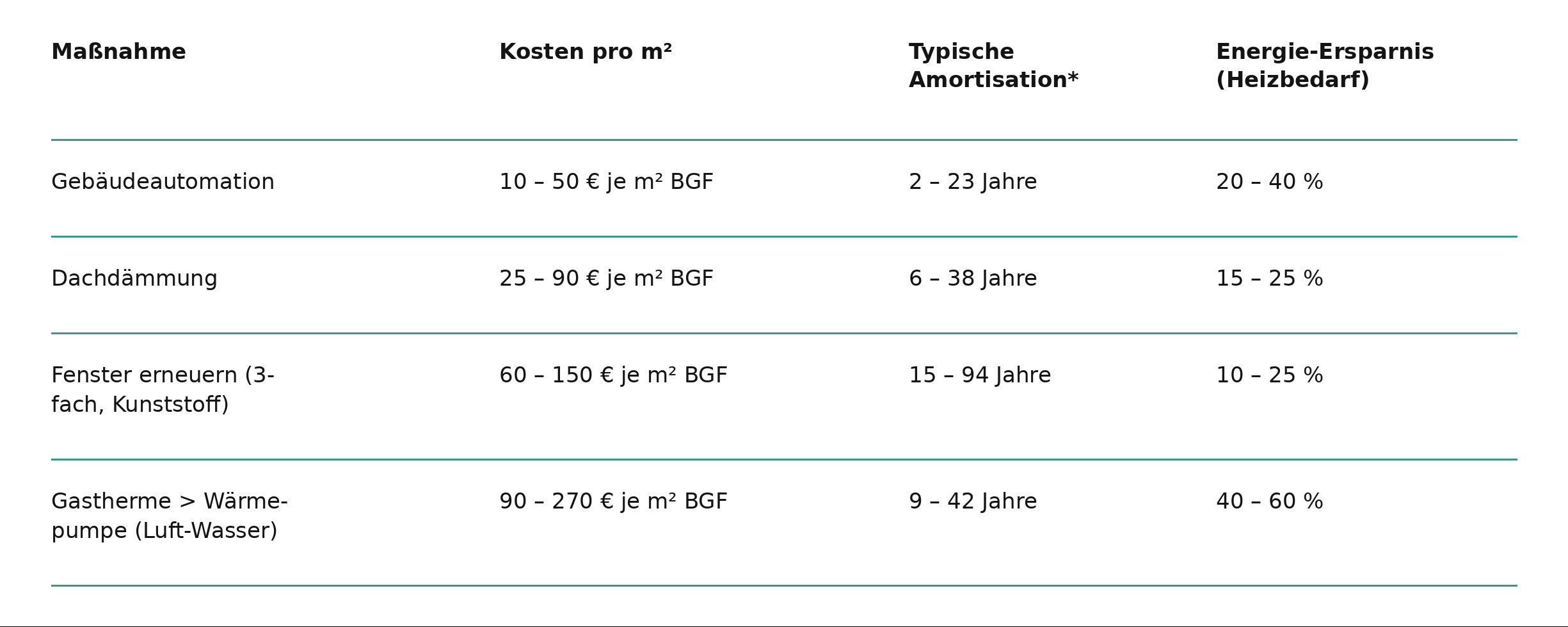
These values are guidelines and can vary significantly depending on the building's condition, location, and labor and material costs—but the scale remains clear. At a fraction of the investment cost, building automation delivers energy savings that can keep pace with significantly more expensive structural measures. For our building owner from the example above, this means: with the budget that a single facade renovation would cost, building automation could be implemented without any issues—leaving funds left over for further measures.
The "low-hanging fruit" in the renovation roadmap
This is exactly what makes building automation the "low-hanging fruit" in the renovation roadmap—the measure that should be implemented first, before larger structural interventions follow. This conclusion is also supported by a study from the consulting firm Gemserv, which compares the use of smart thermostats with thermal insulation, PV integration, and switching to a heat pump: for every €100 invested, a smart thermostat saves at least 10 times more CO₂ than the second-best measure, the heat pump.
Why this is critical for real estate portfolios
What applies to an individual building owner is amplified at the portfolio level: instead of retrofitting every building individually with expensive structural measures, you can achieve widespread impact with relatively low capital expenditure—an approach pursued by solutions like those from viboo for existing buildings. This gives asset and portfolio managers exactly the flexibility they need: to deploy limited renovation budgets precisely where structural measures are truly unavoidable, while still meeting regulatory deadlines such as EPBD requirements.
In a nutshell
- Regulatory deadlines (EPBD, automation mandates, carbon pricing, brown discounts) make action inevitable.
- At €10–50/m², building automation is the most cost-effective of all common renovation measures.
- It offers the fastest payback period, ranging from 2 to 23 years.
- With energy savings of 20–40%, it provides potential on par with significantly more expensive measures.
- For portfolios, it is therefore the ideal first step in a renovation strategy—cost-efficient, quick to implement, and compliant with the law.
This article is part of a series based on the white paper "The Role of Building Automation in the Renovation Strategy for Buildings and Portfolios" by Felix Bünning, co-founder of viboo. You can find the full white paper, including all background information, data, and business models, here: Download white paper as PDF.
Are you planning a renovation for your building or portfolio and want to know how building automation can help? Then please feel free to contact us for a no-obligation consultation.
Weitere Artikel

Regulatory and strategic drivers of building automation
Stricter EU regulation, rising CO₂ prices and new financing logics are putting massive pressure on the building sector. The article shows why energy-efficient renovation and building automation are becoming mandatory — and how regulatory risks can be transformed into strategic benefits.

Building automation as an energy and comfort lever
Building automation demonstrably offers energy savings of up to 35% — through networked TGA control, individual room control and AI-based optimization.

Predictive Control: How buildings learn to think ahead
viboo adds a new layer of intelligence to buildings — one that learns from data, anticipates what’s coming, and keeps them efficient, comfortable, and future-ready.

More control, More flexibility: Granular access management in our building management plattform
Access management in viboo.cloud: Control who has access to which areas of your portfolio or building – securely, flexibly, and efficiently.

Die Rolle der Gebäudeautomation in der Sanierungsstrategie von Gebäuden und Portfolios
Gebäudeautomation wird zur Schlüsseltechnologie im Bestand: Energie sparen, Betrieb verbessern, Sanierungen vorbereiten. Im neusten Whitepaper erfahren Sie, Sie mit vernetzter Regelung Energie- und Taxonomievorgaben erfüllen.

What is a building automation system and how can it help you save energy?
Building automation optimizes heating, ventilation and lighting — saves energy, reduces CO₂ emissions and increases comfort in commercial properties.

Differences between thermostatic and manual radiator valves and their significance for smart thermostats
When retrofitting smart thermostats in existing buildings, the valve type plays a central role. In buildings, he decides whether predictive individual room control is even technically possible.

INVESTMENTexpo in Berlin
In der nächsten Woche ist Mika Kokorniak auf einer der wichtigsten Veranstaltungen der deutschen Immobilienwirtschaft vertreten: der INVESTMENTexpo in Berlin.

Ready to take the next step for the climate?
Find out how viboo can make your buildings more energy efficient — contact us today!